
Some links in this guide are affiliate links. We earn a small commission at no extra cost to you when you book through them, which helps fund this publication.
QUICK ANSWERS
Is Indonesia safe for Black travelers?
Yes, Indonesia is generally safe for Black travelers. It is the world's largest Muslim-majority country and is broadly welcoming and hospitable to visitors. The main concerns are petty theft in crowded parts of Jakarta and natural events like volcanic activity. Outside main tourist areas Black travelers may draw curiosity, but receptions are overwhelmingly friendly.
Is there racism in Indonesia toward Black people?
Indonesians are generally curious and welcoming toward Black travelers rather than hostile. In Jakarta and tourist areas locals are used to foreigners. In smaller cities expect staring, friendly greetings, and photo requests, which is genuine curiosity. There is a local preference for lighter skin (colorism), but overt racism toward visitors is uncommon.
What is the best time to visit Indonesia as a Black traveler?
Indonesia's dry season (April to October) is the best time to visit most of the country — sunny and ideal for temples, beaches, and island hopping. The wet season (November to March) brings heavy afternoon rain. The climate is warm year-round; timing mainly affects rainfall. May, June, and September offer good weather with fewer crowds.
Do Black Americans need a visa for Indonesia?
US passport holders can get an e-visa on arrival (e-VOA) for IDR 500,000, about $30, valid for 30 days and extendable once for another 30. Apply online before you fly at evisa.imigrasi.go.id. For longer stays, the single-entry visit visa (C1, formerly B211A) gives 60 days and can be extended to 180 days in total; many travelers use a visa agent for extensions.
Are there Black expat communities in Indonesia?
The largest Black expat and digital nomad community in Indonesia is in Bali. Beyond Bali, smaller communities of Black professionals, teachers, and embassy staff exist in Jakarta. Yogyakarta has a student and creative scene, while Lombok and the Gili Islands draw nomads and divers. Jakarta-based Facebook groups and pan-Indonesia expat networks help with connecting and settling in.
CITY GUIDES
Indonesia rewards travelers who go beyond Bali. Jakarta is the massive capital. Yogyakarta is the cultural and temple heartland of Java. Lombok offers Bali’s beauty with fewer crowds. The Gili Islands are car-free tropical escapes. (For Bali, see our dedicated Bali guide.)

.jpeg)
.jpeg)
.jpeg)
PRACTICAL ESSENTIALS
Indonesia is welcoming to Black travelers, but a few cultural realities are worth knowing before you go so the small moments do not catch you off guard.
GETTING THERE
Indonesia’s main international gateway is Soekarno-Hatta International Airport (CGK) in Jakarta. There are no direct flights from the US — connect through Tokyo, Singapore, Seoul, Hong Kong, or Doha (total travel time 20-24 hours). Yogyakarta (YIA) and Lombok (LOP) are reached via domestic connections. The Gili Islands are accessed by fast boat from Lombok or Bali. Round-trip economy from the US runs $1,000 to $1,800.
WHERE TO STAY
In Jakarta, central areas like Menteng and the business districts (SCBD) are convenient and safe. In Yogyakarta, base near Malioboro Street or the city center for easy temple access. Lombok’s Kuta (different from Bali’s Kuta) and Senggigi are popular bases. On the Gilis, Gili Trawangan is the liveliest, Gili Air the most balanced. Klook has a strong range for Bali and Java.
GETTING AROUND
In cities, use the Grab and Gojek apps for cars and motorbike taxis — cheap and reliable. Jakarta has a modern MRT line and commuter trains, but traffic is heavy. Yogyakarta is walkable in the center with Grab for temples. On Lombok, rent a scooter or hire a driver. The Gili Islands are car-free — you get around by bicycle or horse cart, and between islands by boat.
MONEY MATTERS
The Indonesian rupiah (Rp) is the currency. As of June 2026, $1 USD = approximately Rp 16,000, so you’ll handle large numbers. ATMs are widely available in cities but scarce on the Gili Islands — bring enough cash before island trips. Cards work at hotels and malls; cash is essential for warungs, markets, and small vendors. Watch for ATM skimmers (use machines attached to banks). Tipping is appreciated but not mandatory.
WHAT TO PACK
Lightweight tropical clothing, swimwear, reef-safe sunscreen, and a light rain jacket. Because Indonesia is Muslim-majority, pack modest clothing (covered shoulders and knees) for cities, mosques, and temples — more so than in Hindu Bali. Bring your own Black hair products, as they’re hard to find; some are available via Tokopedia and Shopee online. Indonesia uses Type C and F plugs (European style). Mosquito repellent is essential.
CULTURAL CONSIDERATIONS FOR BLACK TRAVELLERS
Indonesia beyond Bali offers an incredibly rich and varied experience for Black travelers — from Jakarta’s energy to Java’s ancient temples to the quiet islands. Because most of Indonesia is Muslim-majority (unlike Hindu Bali), a few cultural notes are especially worth knowing.
Curiosity, especially off the tourist track. Jakarta and major tourist areas are used to international visitors, but in Yogyakarta’s neighborhoods, on Lombok, and in smaller towns, Black travelers are far less common. Expect friendly staring, “hello mister/miss!” greetings, and photo requests, particularly from young people. It’s warm curiosity, not hostility — for many locals you may be the first Black person they’ve met in person. A smile and a wave turns it into a positive exchange.
Religion and modest dress. This is the biggest difference from Bali. Most of Indonesia is Muslim, so dress more conservatively than you would on Bali’s beaches — cover shoulders and knees in cities, and dress modestly when visiting mosques (women may need a head covering, usually provided). During Ramadan, be respectful about eating and drinking in public during daylight hours in more conservative areas. At Hindu and Buddhist temples like Borobudur and Prambanan, the usual temple etiquette applies (modest dress, respectful behavior).
Hair and beauty access. As across Indonesia, Black hair products are hard to find outside the Bali expat bubble. Bring your own full supply. Limited options can be ordered through Indonesian online marketplaces (Tokopedia, Shopee), but selection is inconsistent and delivery to islands is slow. There are very few braiders or natural hair stylists outside Bali, so arrive prepared with your hair done or bring everything you need.
Food. Indonesian cuisine is diverse and flavorful — nasi goreng, satay, rendang, gado-gado, and countless regional dishes. As a Muslim-majority country, halal food is the norm and widely available, which is convenient for Muslim travelers. Vegetarian options exist but check for shrimp paste (terasi) and fish. Street food and warungs are cheap and delicious — ease into them and drink bottled or filtered water.
Etiquette and warmth. Indonesians are gentle, polite, and community-oriented. Use your right hand for giving and receiving (the left is considered unclean). Avoid public displays of anger — patience and a calm demeanor are respected. Learn a few words of Bahasa Indonesia (terima kasih means thank you); it’s genuinely appreciated and the language is one of the easier ones to pick up basics in. Modesty, respect, and a friendly smile go a long way across the islands.
.jpeg)
TOP EXPERIENCES
The experiences below are the ones Black travelers consistently rate as worth the cost across Indonesia (beyond Bali). Each is bookable through Klook, the leading tour platform in Asia.
.jpeg)
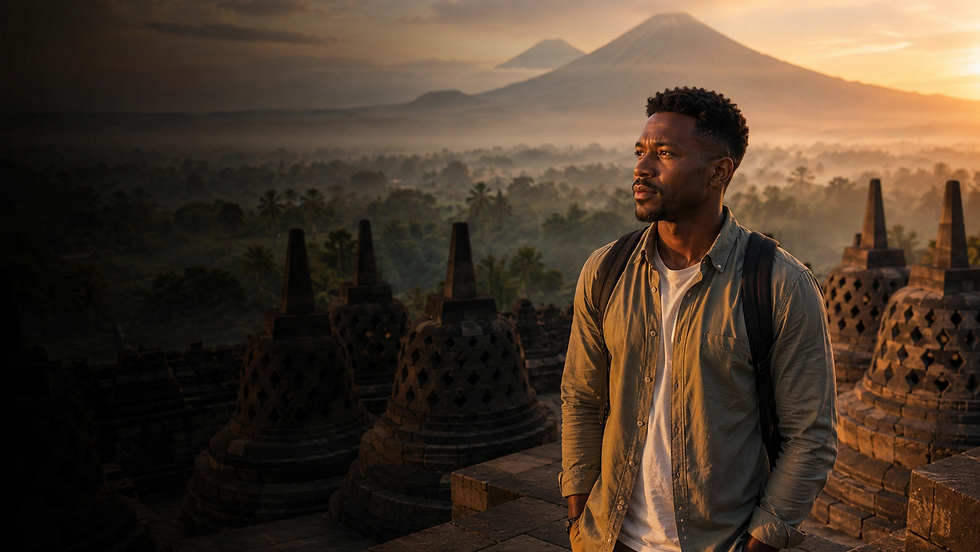
BOROBUDUR TEMPLE SUNRISE TOUR
Watch the sunrise over the world’s largest Buddhist temple — an unforgettable start to a day in Yogyakarta.
.jpeg)
PRAMBANAN TEMPLE & RAMAYANA BALLET
The stunning Hindu temple complex, often paired with the traditional Ramayana ballet performance at night.
.jpeg)
GILI ISLANDS SNORKELING BOAT TRIP
Snorkel with sea turtles and reef fish across the three Gili Islands on a hopping boat tour.
.jpeg)
LOMBOK WATERFALLS & RINJANI FOOTHILLS TOUR
Explore Lombok’s lush waterfalls and the foothills of the mighty Mount Rinjani volcano.
.jpeg)
JAKARTA OLD TOWN & CITY HIGHLIGHTS
The colonial Kota Tua old town, the National Monument, and Jakarta’s mix of history and modern energy.
.jpeg)
YOGYAKARTA BATIK MAKING WORKSHOP
Learn Indonesia’s traditional batik fabric art in a hands-on workshop with local artisans in Yogyakarta.
LIVING IN INDONESIA AS A BLACK EXPAT
Most of Indonesia’s Black expat and digital nomad energy is concentrated in Bali (covered in our dedicated Bali guide). Beyond Bali, Jakarta is the main base for Black professionals, teachers, embassy staff, and those working with international companies, offering big-city amenities at a low cost of living. Yogyakarta draws students and creatives, while Lombok and the Gilis attract divers and a slower-paced nomad crowd. Indonesia’s visa options — the 30-day e-visa on arrival with one 30-day extension, and the C1 visit visa for up to 180 days — make longer stays possible, and most expats use local visa agents to handle the process.
LATEST INDONESIA STORIES
Indonesia has become a top destination for Black expats


